
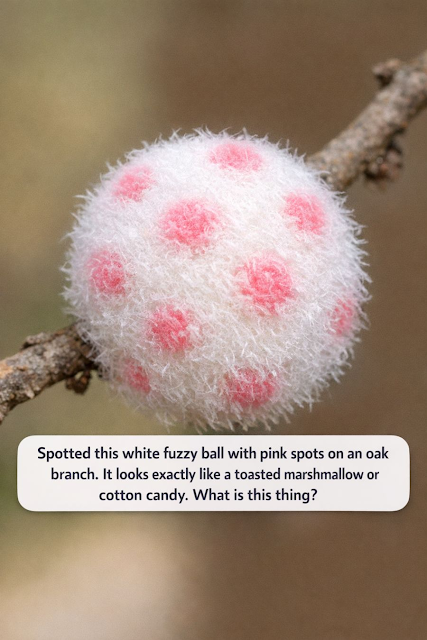
In gall formations, these fibers can grow unusually long and dense, creating a fluffy appearance.
This serves several purposes:
It helps insulate the larva inside.
It may discourage predators.
It can regulate moisture within the gall.
The result is something that looks almost soft enough to touch—though it’s usually best not to disturb it.
Why Pink Spots Appear
The pink or reddish spots that appear on some galls often come from plant pigments called anthocyanins. These pigments are common in many plants and are responsible for red, purple, and pink colors in leaves and fruits.
Several factors can influence these colors:
Sunlight exposure
Temperature changes
The species of gall wasp involved
The stage of gall development
As the gall ages, the color may shift from pale pink to deeper red or brown.
Other Creatures That May Live in Galls
Interestingly, the original gall wasp isn’t always the only resident.
Over time, other insects may invade the gall, including:
Parasitoid wasps
Small beetles
Mites
Tiny flies
Some of these insects prey on the gall maker, while others simply use the structure as shelter.
Because of this, a single gall can become a miniature ecosystem supporting several species.
Could It Be Something Else?
While oak galls are the most common explanation, a few other natural phenomena might also resemble a fluffy white ball on a tree branch.
These include:
1. Woolly Aphid Colonies
Certain aphids produce waxy filaments that make them appear fluffy and cotton-like. Large groups can form white fuzzy clusters on branches.
2. Fungal Growth
Some fungi create cottony structures on wood, especially when moisture levels are high.
3. Insect Egg Masses
Some insects lay eggs in protective foam-like structures attached to plants.
However, these usually have different textures or locations compared to classic oak galls.
Should You Touch or Remove It?
If you find one of these fuzzy balls on a tree, it’s best to leave it alone.
While it may look strange, it is part of a natural process. Removing it doesn’t provide much benefit and may interrupt the life cycle of the insects involved.
Additionally:
It won’t harm you.
It usually won’t harm the tree.
It contributes to the biodiversity of the environment.
Observing it without disturbing it is often the best approach.
Nature’s Strangest Designs
The natural world is full of bizarre and fascinating structures, and oak galls are among the most unusual. What appears at first glance to be a piece of cotton candy stuck to a tree branch is actually the result of a complex biological interaction between plant and insect.
This relationship shows how even tiny organisms can influence much larger ones in remarkable ways.
From the outside, a fluffy white ball with pink spots might seem mysterious or even magical. But once you understand the science behind it, it becomes even more impressive.
Final Thoughts
If you ever come across a white fuzzy ball with pink spots on an oak branch, you’re likely looking at an oak gall created by a tiny gall wasp. Although it may resemble a toasted marshmallow or cotton candy, it’s actually a natural plant growth designed to house a developing insect.
These strange formations remind us that nature often produces shapes and textures that rival anything humans could imagine. What first appears puzzling or unnatural often turns out to be an ingenious biological process unfolding quietly in the background.
So the next time you notice something odd growing on a tree branch, take a closer look. You might just be witnessing one of nature’s many hidden stories.
