
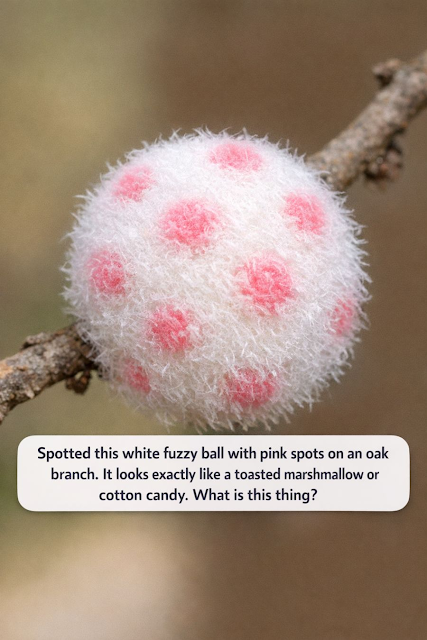
Spotted a White Fuzzy Ball With Pink Spots on an Oak Branch? Here’s What It Might Be
Imagine walking through a quiet forest or even your backyard and noticing something unusual clinging to the branch of an oak tree. At first glance, it looks almost like a small dessert someone forgot there—a soft white ball with pink spots that resembles a toasted marshmallow or a piece of cotton candy. It seems fluffy, slightly mysterious, and completely out of place in nature.
If you’ve ever come across something like this, you’re definitely not alone. Many people have reported seeing strange fuzzy growths or colorful clusters attached to tree branches, especially on oak trees. While they might look like fungi, candy, or even some sort of strange plant growth, these curious objects usually have a fascinating biological explanation.
Let’s take a closer look at what this mysterious white fuzzy ball with pink spots could actually be.
First Impressions: Why It Looks So Strange
One of the main reasons people are puzzled when they encounter these objects is their appearance. Nature rarely produces something that looks quite so whimsical. The white fuzzy texture can resemble cotton, foam, or spun sugar. Meanwhile, the small pink spots or patches make it look almost decorative, as if someone intentionally placed it there.
Because of this unusual appearance, people often assume several possibilities:
A rare mushroom or fungus
Some kind of insect nest
A plant disease or mutation
Bird droppings mixed with mold
A strange egg cluster
However, the real explanation is often more surprising than any of these guesses.
The Likely Culprit: An Oak Gall
In many cases, these strange fluffy balls are oak galls. Oak galls are unusual plant growths that form when tiny insects—most commonly gall wasps—interact with oak trees.
Gall wasps are extremely small insects, often only a few millimeters long. Despite their tiny size, they have a remarkable ability to manipulate plant tissue. When a female wasp lays her eggs inside the tissue of an oak leaf, twig, or bud, she releases chemicals that cause the tree to grow a protective structure around the developing larva.
This structure is called a gall.
Essentially, the insect tricks the tree into building a tiny nursery that provides both food and shelter for the developing baby wasp.
Why Oak Galls Come in So Many Shapes
One of the most fascinating things about oak galls is their diversity. Different species of gall wasps cause the tree to form different shapes and textures. Some look like tiny apples. Others resemble spiky balls, discs, cones, or even small coral-like structures.
In the case of the fluffy white ball with pink spots, the gall may have a cotton-like surface made up of fine plant fibers. These fibers can trap moisture and protect the insect inside.
