
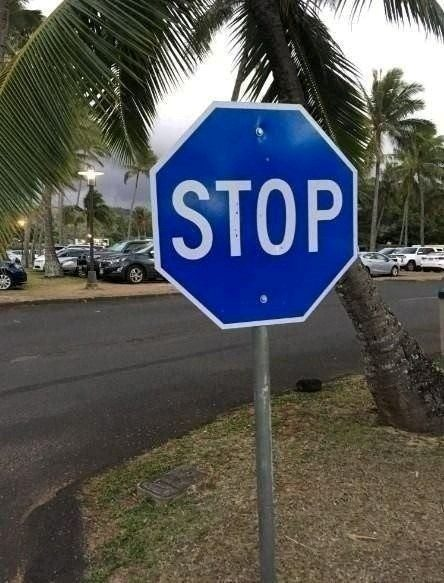
1. Private Property
One of the most common places to find a blue stop sign is on private property. Parking lots, gated communities, industrial sites, and private roads sometimes use non-standard signage.
In these areas, property owners may install signs that resemble official ones but use different colors to distinguish them from public road signs. A blue stop sign in this context is often intended as a general instruction rather than a legally enforceable command.
2. Decorative or Novelty Signs
Some blue stop signs are purely decorative. They may be used in themed environments, artistic installations, or even as humorous or novelty items.
For example, a business might use a blue stop sign as part of its branding, or a homeowner might display one as a quirky addition to their driveway. In these cases, the sign is not meant to function as a traffic control device at all.
3. Temporary or Improvised Signs
In rare situations, a blue stop sign might be used temporarily when a standard sign is unavailable. This could happen during construction or in remote areas.
However, such use is generally discouraged because it can confuse drivers and reduce the effectiveness of traffic control.
The Psychology of Color in Road Signs
Colors play a powerful role in how we interpret road signs. Each color carries a specific meaning:
Red: Stop, prohibition, danger
Yellow: Warning or caution
Green: Direction and guidance
Blue: Information or services
Blue is typically associated with informational signs, such as those indicating rest areas, hospitals, or services. It does not carry the same sense of urgency as red.
This is why a blue stop sign feels so unusual—it combines a color associated with calm information with a shape and message associated with urgency.
Why a Blue Stop Sign Can Be Confusing
Driving requires quick decision-making. When a sign does not match expectations, it can create hesitation or uncertainty. A blue stop sign may cause drivers to question whether it is legitimate, potentially delaying their response.
This confusion highlights the importance of standardized signage. Consistency ensures that all drivers, regardless of experience or location, can understand and react appropriately.
What Should You Do If You See One?
If you encounter a blue stop sign, the safest approach is simple: treat it as you would a regular stop sign.
Even if it is not legally enforceable, it is likely placed there for a reason—perhaps to prevent accidents in a busy parking lot or to guide traffic in a private area. Stopping ensures safety for yourself and others.
When in doubt, prioritizing caution is always the best choice.
Could Blue Stop Signs Ever Become Official?
It’s unlikely that blue stop signs will replace red ones in official traffic systems. The current standards have been developed over decades and are based on extensive research into visibility, recognition, and driver behavior.
Changing such a fundamental aspect of road signage would require global coordination and could introduce unnecessary risks. For this reason, transportation authorities are unlikely to adopt blue stop signs for public roads.
The Internet’s Fascination with Blue Stop Signs
In recent years, photos of blue stop signs have circulated widely online, sparking debates and theories. Some people speculate that they indicate special rules or hidden meanings, while others assume they are mistakes or pranks.
This fascination reflects a broader human tendency to question anything that deviates from the norm. A simple color change can transform a familiar object into a mystery worth exploring.
Lessons from the Mystery
The curiosity surrounding blue stop signs offers a few important lessons:
We rely heavily on visual standards: Even small deviations can disrupt our understanding.
Context matters: The meaning of a sign can depend on where it is placed.
