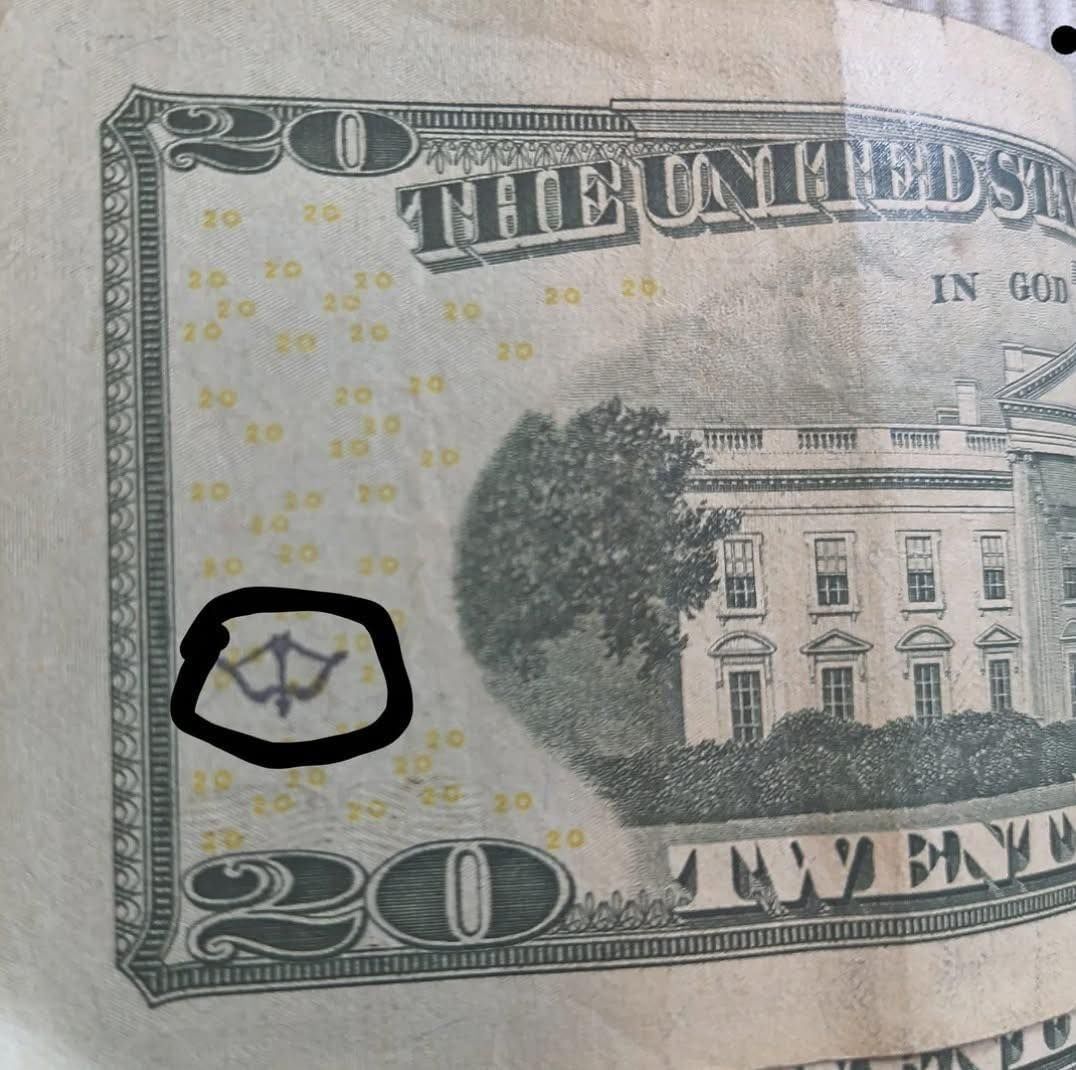
If you have ever taken a moment to really look at a U.S. dollar bill, not just glance at it but study it closely, you may have noticed something odd. Tiny shapes. Strange marks. Lines or figures that do not immediately make sense. Among the most talked-about of these details is a dark shape that some people describe as looking like a bow and arrow.
At first glance, the shape can feel intentional. It almost looks placed there on purpose, as if it were a hidden symbol waiting to be discovered. For many people, this instantly sparks curiosity. Is it a secret sign? A hidden message? A symbol tied to history, power, or something more mysterious?
Over the years, this small mark has inspired countless theories. Some claim it is linked to ancient symbolism. Others believe it is a secret identifier or a coded message placed on money by design. Social media posts often amplify these ideas, showing close-up images of dollar bills and asking dramatic questions that invite speculation.
But when you move past the mystery and look at how money is actually made, the real explanation turns out to be much more practical—and far more believable.
Looking Closely at the Mark
The shape people refer to is usually found in areas of the bill that already contain complex background patterns. On modern U.S. bills, especially higher denominations, there are repeating numbers, fine lines, and layered colors designed to prevent counterfeiting.
Within these detailed backgrounds, a darker spot can sometimes stand out. When the shape happens to resemble something familiar, like a bow and arrow, the mind immediately connects the dots.
However, this shape is not a symbol that was intentionally added. It is not artwork, a logo, or a message hidden by designers. It is not part of the official layout of the bill.
Instead, it is the result of something that happens naturally during the printing process.
The Reality of Printing Currency
Printing money is one of the most precise manufacturing processes in the world. U.S. bills are produced using multiple printing methods layered on top of one another. Each stage applies different inks, textures, and details.
Despite the incredible precision involved, no industrial process is completely free of variation. When millions of bills are printed every single day, tiny inconsistencies can occur. These are not mistakes in the sense of failure; they are minor imperfections that come with mass production.
The so-called bow and arrow shape is one of these imperfections. It may be caused by a small ink buildup on a printing plate, a brief transfer of ink from another sheet, or a momentary mechanical contact during printing. When that irregularity overlaps with an already complex background pattern, it can create a shape that looks deliberate, even though it is not.
Why Our Brains See Symbols
One of the most important parts of this story has nothing to do with money at all. It has to do with how the human brain works.
Humans are pattern-seeking by nature. Our brains are designed to recognize familiar shapes quickly. This ability helped our ancestors survive, allowing them to spot faces, animals, or dangers in their environment. But this same ability can also cause us to see meaning where none exists.
This phenomenon is known as pareidolia. It is the reason people see faces in clouds, figures in shadows, or animals in rock formations. When a random shape loosely resembles something recognizable, the brain fills in the gaps.
On a dollar bill, the conditions are perfect for this effect. The background is busy but structured. The mark is darker than its surroundings. The shape vaguely resembles a familiar object. Together, these elements encourage the brain to interpret coincidence as intention.
